
Shoulder Pain
Most shoulder pain is not in the shoulder. It is in how the shoulder is loading under a restricted thorax.
Written by Alexander Khang, ISRM Level 5 Soft Tissue Therapist. 935 sessions delivered. 265+ five-star reviews.
What is Shoulder Pain?
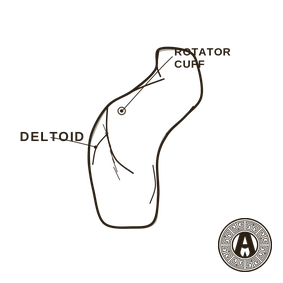
Shoulder pain in a soft tissue practice typically presents as rotator cuff tendinopathy, subacromial impingement, or non-specific shoulder pain with restricted range. True rotator cuff tears and labral pathology require orthopaedic investigation.
What soft tissue work addresses effectively is the majority of shoulder pain that comes from muscle imbalance, thoracic restriction, and poor scapular mechanics: cases where the ball of the humerus is not staying centred in the socket because the surrounding tissue is not allowing it.
Why it happens
The shoulder relies on dynamic stability, the rotator cuff muscles centre the humeral head while the larger muscles move the arm. When the thorax is stiff or the scapula cannot move freely, the rotator cuff is working at a mechanical disadvantage on every arm movement.
Over time, the supraspinatus tendon gets compressed in the subacromial space. This is a positioning problem, not primarily a tendon problem.
"Shoulder impingement is rarely a shoulder problem. It is a thoracic and scapular problem that the shoulder pays for."
How we treat Shoulder Pain
Assessment
We look at how the shoulder, shoulder blade and upper back move together, and whether you need a scan first.
Tension Release
Hands-on soft tissue work around the shoulder and upper back, aimed at what the assessment found.
Strength Rebuild
Building strength and control so the shoulder can work from a better position.
Relevant Clinical Articles
SOFT TISSUE
Rotator cuff strengthening: what actually works
Rotator cuff exercises are frequently prescribed and frequently wrong. A clinical guide to which muscles need loading, in what positions, and why.
Read articleTREATMENTS
Is cupping good for shoulder pain?
Cupping works for shoulder pain caused by posterior chain restriction and fascial tightness, not rotator cuff pathology. A clinical answer.
Read articleSOFT TISSUE
Frozen shoulder: what it is and what soft tissue therapy can offer
Adhesive capsulitis has three distinct phases with different clinical approaches. What soft tissue therapy can and cannot do for each phase.
Read articleTreating this properly
This guide explains the problem. The programme treats it: a full assessment, then a course of hands-on treatment with the same practitioner.
See the Shoulder Pain ProgrammeNot sure where to start?
Bring your history, your scan results, and your questions. The assessment is a clinical conversation, not a sales pitch.
Achilles Clinic
260 Pentonville Road
London, N1 9JY, United Kingdom
ISRM Level 5 Diploma in Soft Tissue Therapy